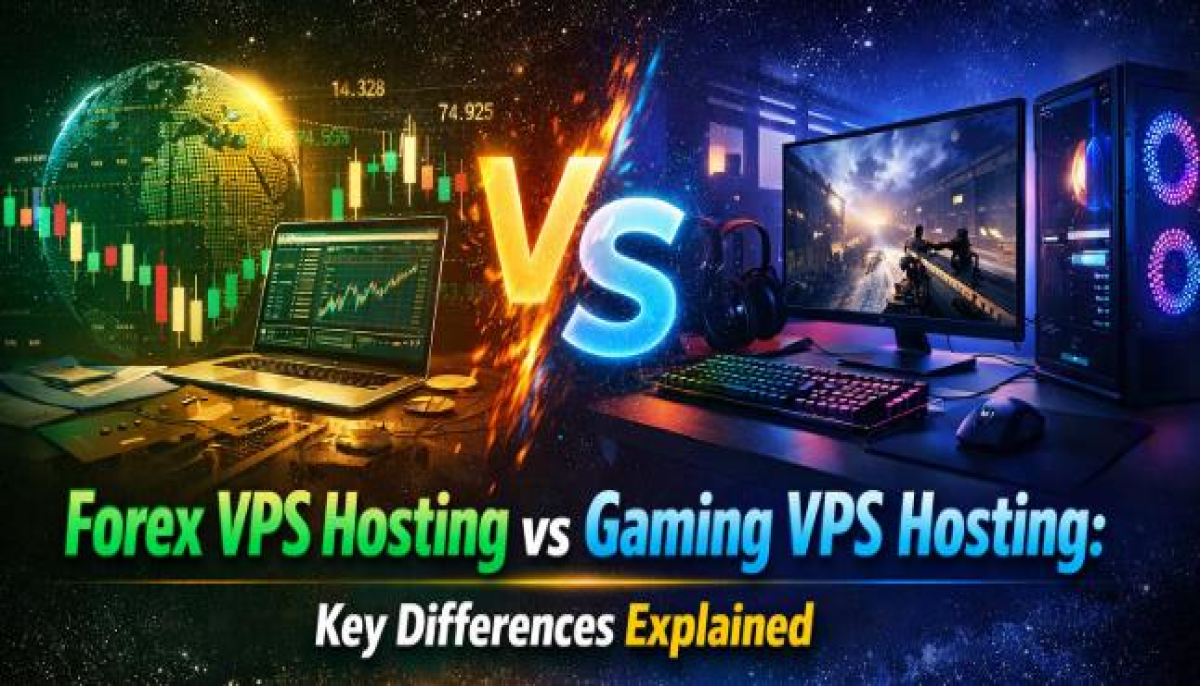
Virtual Private Server (VPS) hosting is the most preferred choice for websites and applications that demand dedicated resources, stable performance, and maximum control than shared hosting. Anyhow, all VPS services are not the same. Forex VPS hosting and Gaming VPS hosting are designed for totally different purposes. Forex VPS supports fast trade execution. On the other hand, Gaming VPS supports efficient multiplayer gameplay. Each hosting environment deploys different hardware, network settings, and performance preferences to fulfil specific requirements. This blog entails a detailed comparison of forex VPS hosting vs. gaming VPS hosting for users. So that you can make the right decision for your business needs.
What is VPS Hosting?
VPS hosting a service that gives more control and scalability options than shared hosting. Thus, It is an ideal option for businesses and websites needing more control, flexibility and cutting-edge security.
VPS hosting environments offer:
Dedicated resource allocation
Custom OS installation
Advanced configuration control
Improved security isolation
Predictable performance stability
VPS hosting is often used for:
trading systems,
gaming servers,
web applications,
SaaS platforms, and
automation tools
Forex VPS Hosting
Forex VPS hosting is designed for automated trading platforms like MetaTrader 4 and MetaTrader 5. It gives consistent connectivity between trading bots i.e Expert Advisors and broker servers.
Forex hosting gives ultra-low latency execution and 24/7 uptime stability.
Key features:
Location-based hosting near financial exchange data centers
Optimized routing to brokerage servers
Low-latency network backbone
Ideal uptime SLAs (99.9%–99.99%)
Stable CPU allocation for algorithmic trading
Gaming VPS Hosting:
Gaming VPS hosting is optimized for multiplayer game servers like Minecraft, Counter-Strike 2, and Grand Theft Auto V.
Gaming hosting offers real-time player interaction with least lag and high resource accessibility.
Key features:
High clock-speed CPUs
Larger RAM allocations
Fast NVMe storage
DDoS mitigation
Optimized packet handling
Comparison of Different Features: forex VPS hosting vs. gaming VPS hoting:
Latency sensitivity and network optimization:
Forex VPS:
Latency is essential for operations. Execution speeds usually take 1–5 ms connectivity to broker servers. Therefore, Hosting providers typically colocate servers near financial hubs such as London, New York, or Tokyo.
Network optimization consists of:
Direct peering routes
Low jitter connections
Minimal packet loss
Gaming VPS:
Latency is crucial but less extreme. Thus, acceptable ping ranges often fall between 10–40 ms for effective gameplay. Optimization targets on:
Player geographic allocation
Bandwidth stability
Anti-DDoS filtering
Forex needs systematic latency. On the other hand, gaming demands constant latency.
Hardware Resource Allocation (CPU, RAM, Storage):
Forex VPS:
1–2 dedicated vCPUs
2–4 GB RAM
Moderate SSD storage
CPU stability preferred over burst performance
Gaming VPS:
4+ vCPUs (high clock speed)
8–32 GB RAM (depending on player count)
NVMe storage for instant data access
Burst performance for peak sessions
Gaming hosting environments need higher computational output than forex hosting systems.
Uptime and reliability expectations:
Forex VPS:
Downtime straight away affects trade execution. A 30-second interruption could result in missed market entries or exits. There is expectation in Uptime to exceed 99.99% SLA.
Gaming VPS:
High uptime is important, but minor interruptions are less financially crucial. However, Standard expectations range from 99.9% to 99.95%.
Forex prefers financial stability. On the contrary, gaming favors player experience consistency.
Security requirements and risk management:
Forex VPS:
Secure broker connectivity
Encrypted trading sessions
Firewall hardening
Access control
Protection against data breaches
Risk exposure is financial.
Gaming VPS:
DDoS protection
Anti-cheat system compatibility
Player data security
Mod/plugin isolation
Risk exposure is service distortion and reputation damage.
Software environment and configuration differences:
Forex VPS:
Windows Server environments usually needed
Trading terminal installations
Automated script execution
Least graphical overhead
Gaming VPS:
Linux-based environments common
Game engine runtime optimization
Plugin ecosystems
Port forwarding configuration
Forex emphasizes efficient automation; gaming prefers performance-intensive real-time processing.
Scalability and flexibility:
Forex VPS:
Scaling is performed vertically when you increase CPU/RAM with the increase in trading bots. However, resource requirements remain relatively constant.
Gaming VPS:
Scaling may be done vertically or horizontally by increasing nodes for more player bases. Demand changes on the basis of active users.
Gaming infrastructures often need more elasticity.
Cost infrastructure and pricing models:
Forex VPS:
Low-capacity packages
Premium pricing for low latency
Stable monthly expenses
Gaming VPS:
Higher base resource expenditure
Bandwidth-intensive pricing
Add-ons for DDoS mitigation
Forex pricing shows network optimization; while gaming pricing shows hardware intensity.
Management level and technical expertise needed:
Forex VPS:
Basic Windows administration expertise
Trading platform setup
Firewall configuration
Gaming VPS:
Linux server management
Game server configuration
Plugin troubleshooting
Performance tuning
Gaming VPS usually requires higher technical expertise.
Technical Efficiency Comparison: Forex vs Gaming VPS Hosting
Ping Requirements (ms Range):
Forex VPS: 1–5 ms suitable
Gaming VPS: 10–40 ms acceptable
CPU preference differences:
Forex: forex gives stable, consistent CPU cycles
Gaming: gaming offers high-frequency, multi-core burst performance
RAM suggestions:
Forex: 2–4 GB is sufficient
Gaming: 8–32 GB is suitable but depends on players/mods
SSD vs NVMe importance:
Forex: Standard SSD is sufficient
Gaming: NVMe strongly preferred for faster world loading and reduced lag
Network Routing Importance:
Forex: Direct broker routing is essential
Gaming: Balanced routing is best for distributed player base
When to opt for Forex VPS?
Choose Forex VPS if:
You operate automated trading bots
Millisecond latency impacts profitability
You need 24/7 trading uptime
Your broker server location is predictable
You deploy MetaTrader platforms
Forex VPS is specialized for financial accuracy and execution stability.
When to opt for a gaming VPS?
You can select for Gaming VPS if:
You host multiplayer servers
You need high RAM and CPU
You handle huge player communities
You demand DDoS mitigation
You install mods or plugins
Gaming VPS is configured for real-time interactive workloads.
Comparison table of features: Forex VPS hosting vs. gaming VPS hosting
How to choose the right VPS for your requirements?
You have to describe your workload type, like trading vs. multiplayer gaming.
Determine latency demands.
Assess CPU and RAM usage.
Identify geographic server location importance.
Assess uptime influence tolerance.
Validate security exposure risks.
Compare long-term scalability requirements.
Quantify complete cost of ownership.
If you opt for an inappropriate VPS architecture, it leads to performance inefficiencies, higher latency, and additional expenditure.
Conclusion
Selection between Forex and Gaming VPS totally depends on workload accuracy and performance needs. With Navicosoft, businesses and traders get optimized infrastructure, low-latency connectivity, scalable resources, and ideal uptime tailored. These features are particularly designed for trading systems or high-performance multiplayer gaming environments.
FAQs
1. Is Forex VPS faster than Gaming VPS?
Forex VPS is designed for latency; however, Gaming VPS prefers computational power.
2. Can I deploy a Gaming VPS for Forex trading?
Technically, you can use it. But latency optimization may not go well with dedicated Forex VPS performance.
3. Does Forex VPS need high RAM?
No, most trading setups perform effectively with 2–4 GB RAM.