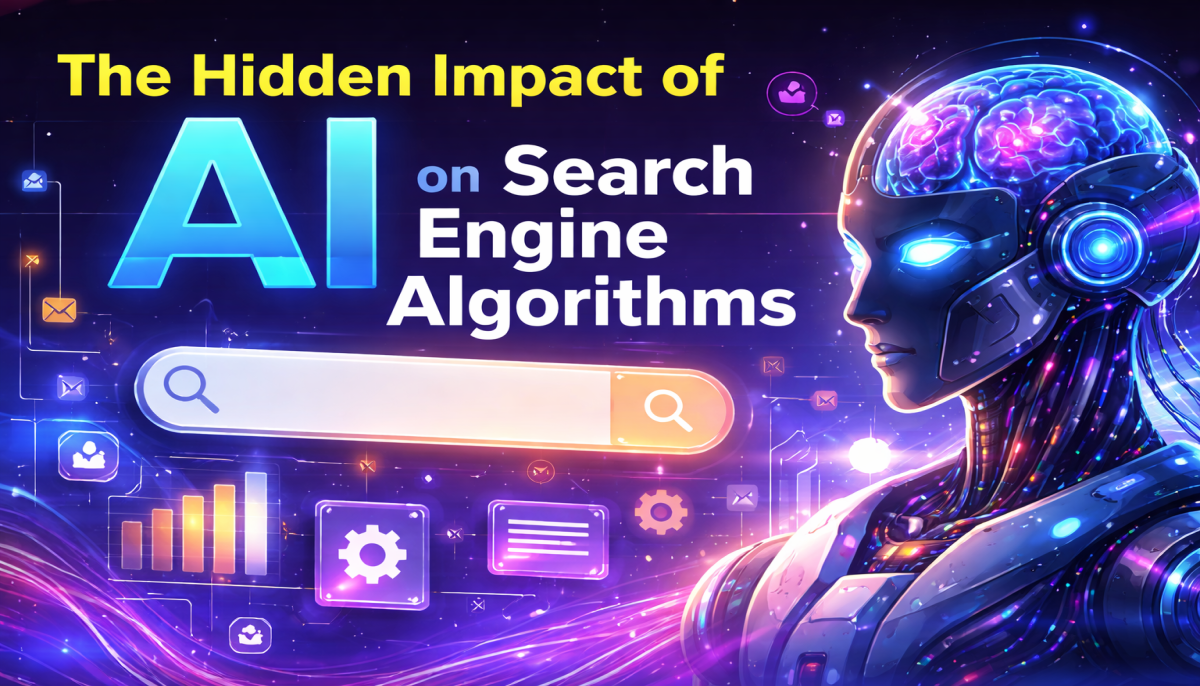
Artificial intelligence is rapidly emerging as a part of search engine algorithms that is modifying the ways how information is ranked, searched, and used. These systems now perfectly understand what users mean, their background, and their behavior. This modification impacts how visible websites are and how companies battle for visibility online. Many businesses don’t realize its complete effect. This makes it significant to comprehend how AI is transforming search results and gross online success in this accelerating digital world.
Evolution of Search engine algorithms:
Search engine algorithms have transformed from simple keyword matching to modern, AI-driven systems. Early engines prefer simple queries. However, advanced engines assess user intent, context, and behavior. Upgrades such as Google RankBrain and BERT have enhanced precision. This helps to deliver more relevant and tailored search results for users globally.
Core AI technologies powering search:
Here are some significant AI technologies that power up search results:
Machine Learning (ML): This technology allows search engines to learn from user behavior and constantly deliver better results.
Natural Language Processing (NLP): NLP enables in understanding user requests, intent, and engaging language.
Deep Learning: The technology leverages neural networks to examine complicated patterns and provide best relevant results.
Semantic Search: This tech understands meaning behind requests instead of depending only on keywords.
Computer Vision: The technology assesses graphics and videos to increase visual search functionalities.
Knowledge Graphs: Knowledge graphs join related data to deliver exact and adaptive information.
Voice Search AI: Voice AI supports voice assistants to process and react to spoken requests effectively.
The new era of AI-Driven search:
Shift from keywords to user intent:
Search has switched from keywords to analyzing user intent, context, and meaning. AI now categorizes requests and gives context-aware output. This gives highly improved, personalized, and precise information for users across multiple searches.
Personalization and user-centric search:
Personalization and user-centric search deploy behavioral data and instant processing systems. This tactic helps modify results and improves relevance. Meanwhile this mechanism balances a wide variety in SERPs on the basis of individual user preferences, interests, and browsing patterns.
3.Rise of AI-powered search interfaces:
Chat-based search, virtual assistants, and chatbots support intuitive interactions. Moreover, visual and multimodal search help users to integrate text, graphics, and speech. This makes search experiences more organic, approachable, and proficient across devices.
4. AI-Generated search results:
AI-generated search results transform search engines into AI answer systems that deliver direct responses. The system enhances zero-click searches and AI summaries. This results in minimizing natural traffic and impacting CTR for websites considerably.
How do SEO strategies transform due to AI?
SEO strategies are changing due to AI by prioritising more on user intent, linguistic search, and top-notch content. Marketers now tailor for natural language queries, AI summaries, and personalized results. Meanwhile this reduces reliance on keywords and modifying to zero-click search environments.
Challenges and risks of AI in search:
Some challenges and risks of AI in search are as follows:
Least search result variety due to algorithmic personalization.
Distortion in AI-generated rankings and summaries.
Wrong information or fabricated responses in AI feedback.
Least visibility for natural and smaller websites like traffic relocation.
Strong dependence on AI-generated responses such as reduced critical assessment by users.
Poor accountability in ranking and data recovery mechanisms.
Future trends in AI search algorithms:
Following are some points depicting future trends in AI search algorithm:
Emergence of generative AI answer systems as a replacement of traditional SERPs.
Maximum use of integrated search systems like text, voice, and image integration.
Greater live personalization on the basis of user behavior and context.
Growth of interactive and chatbot-based search experiences.
Enhanced integration of AI search with regular apps and digital ecosystems.
Strategic implications for businesses:
Certain strategies are helpful for businesses:
SEO optimization to AI search: Businesses must modify content for AI-generated responses and zero-click feedback.
Shift toward brand authority: Effective digital integrity and E-E-A-T signals become necessary for visibility.
Least natural traffic dependence: Companies require multi-channel acquisition beyond regular search.
Content optimized for AI analysis: Structured, conceptually rich content enhances opportunities of being exposed by AI systems.
Integration with interactive channels: Businesses must make changes for chat-based and voice-driven search ecosystems.
Conclusion:
AI is reforming search engine algorithms by improving customization, modifying ranking systems, and transforming SEO policies. Businesses should optimize developing AI-driven search environments. Companies like Navicosoft help businesses through seo services to maintain visibility, enhance engagement, and stay competitive in the fast growing digital market.
FAQs:
How does AI affect SEO strategies today?
AI transforms SEO toward systemized content, user intent optimization, and authoritative ranking signals.
Why is AI significant in search engine evolution?
AI increases relevance, improves personalization, and allows faster, more precise search results delivery.
Does AI reduce organic website traffic?
AI-generated responses usually lessen clicks by directly answering user requests instantly.