Mustakshif Shariah Board Rulings on E470A
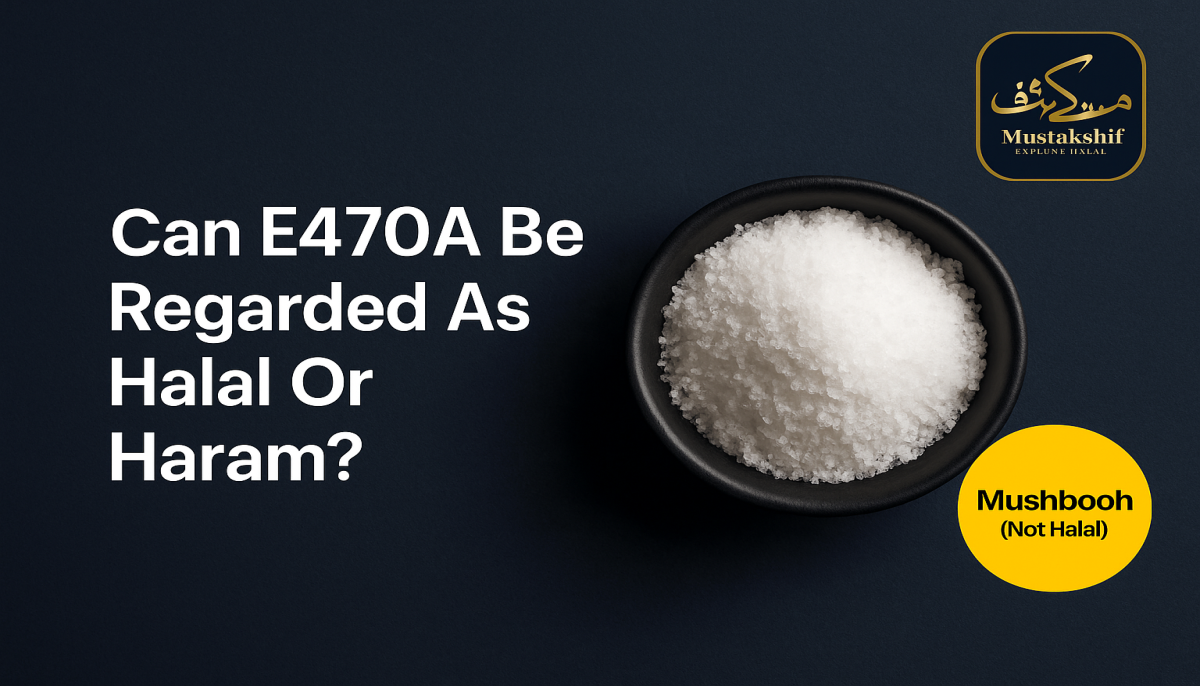
According to Mustakshif Shariah Board, E470A is classified as mushbooh due to the ambiguity of its origin. If the fatty acids come from animal fats, they must be sourced from halal-slaughtered animals. If plant-derived, such as from palm oil, its use is generally permissible. Without clear source labelling, the status remains doubtful in Islamic dietary terms.
Scholarly opinions
There are no specific fatwas issued for E470A to date. Islamic scholars suggest verifying the source before consumption to ensure permissibility.
Introduction of E470A
E470A, known as ammonium salts of palmitic and stearic acids, is a food additive classified as an emulsifier and stabiliser. This food additive is also referred as ammonium palmitate or ammonium stearate, Salts of myristic and fatty acid salts of palmitic and stearic acids, due to their association with the broader group of fatty acid salts. This ingredient helps maintain consistency in processed foods and prevents clumping in powdered products.
Understanding the extraction process
E470A is a food additive used as an emulsifier, stabiliser, and anti-caking agent. The source includes both animal and plant fats, commonly tallow and palm oil. Production starts with the saponification of fats rich in palmitic and stearic acids. Next, the free fatty acids are neutralised using ammonia to form ammonium salts. After this, the resulting salts go through purification to remove any residual materials.
Where and how is it used?
E470A helps stabilise mixtures of oil and water in food items like margarine and ice cream.
- Its anti-caking property keeps powdered foods from clumping and sticking.
- This additive plays a key role in maintaining texture and appearance in processed goods.
- Food products benefit from improved shelf life and a smoother consistency.
- Cosmetic formulations like creams rely on E470A for uniform structure.
- Pharmaceutical tablets are used as lubricants during manufacturing.
- The plastics and rubber industries apply it to aid processing and product release.
Final words
E470A is a multi-industry additive derived from fatty acids and ammonia. Its origin should be checked to determine whether it aligns with halal dietary standards.