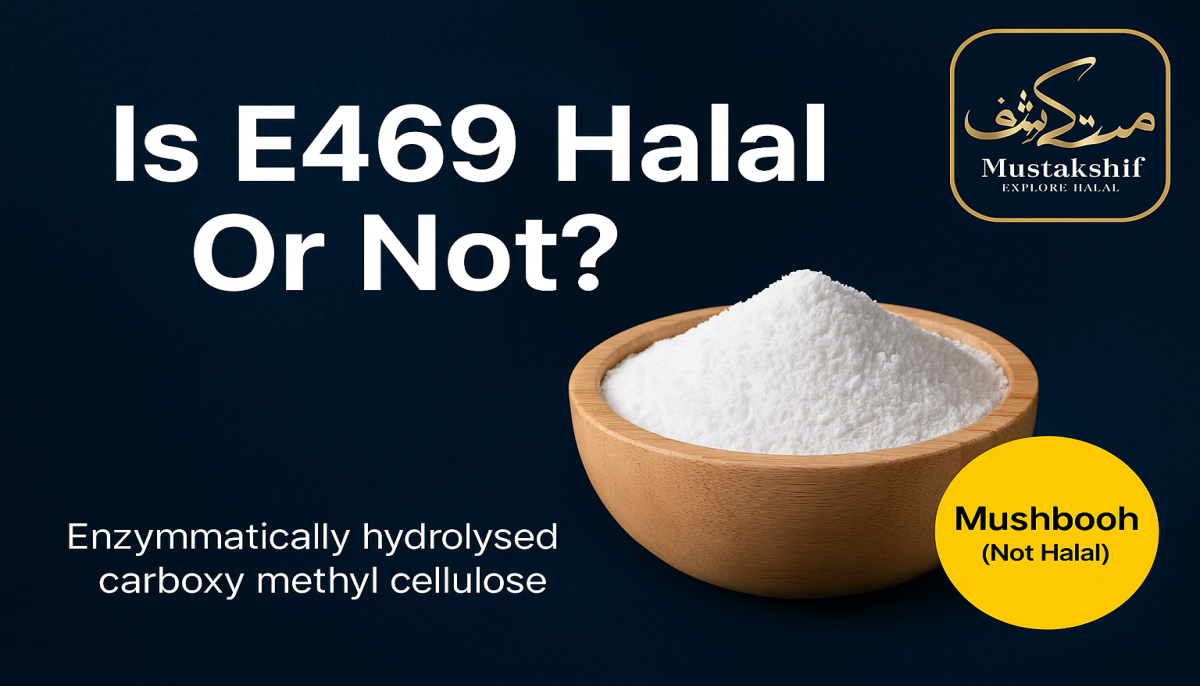
Mustakshif Shariah Board Rulings on E469
According to Mustakshif Shariah Board, E469 is marked as mushbooh. This status arises due to the uncertainty surrounding the enzymes involved in its hydrolysis. If these enzymes come from non-halal sources, concerns may arise. Since production details are not always disclosed, the permissibility remains questionable for some dietary observers.
Scholarly opinions
No widely recognised fatwas have been issued specifically for e469. As it falls under the mushbooh category, many scholars advise avoiding it unless the source of the enzymes is clearly halal-certified. Verification from manufacturers or reliable halal authorities may help resolve uncertainty.
Understanding the additive E469
E469, enzymatically hydrolysed carboxy methyl cellulose, is a functional food additive. It carries the e-code e469 and has alternative names, including enzymatically hydrolyzed carboxymethyl cellulose and hydrolyzed carboxymethyl cellulose. This ingredient appears in a wide range of applications, mostly because of its thickening, stabilising, and emulsifying qualities. This modified cellulose derivative enhances texture and consistency in products.
Extraction and production
This additive is made from cellulose, a naturally occurring polymer found within plant cell walls. Cellulose is taken from raw materials like cotton or wood. It then undergoes chemical treatment to introduce carboxymethyl groups. Following that, enzymes break down this modified material, improving its solubility and performance. Final purification ensures food-grade quality and safety.
How it used across industries?
E469 works well in food, cosmetic, pharmaceutical, and textile products.
Texture enhancer: It increases thickness in sauces, dressings, and desserts without changing the flavour.
Ingredient disperser: Maintains even distribution in soups, beverages, and dairy products.
Oil-water mixer: Supports the blending of liquids that usually stay separate.
Outside the food industry:
Cosmetics: Provides body and texture in shampoos, creams, and gels.
Medicines: Functions as a binder in tablets and thickens oral suspensions.
Textiles: Assists in coatings and finishing treatments.
Closing thoughts
Enzymatically hydrolysed carboxy methyl cellulose, or e469, is a versatile additive with broad uses. Whether used in food, healthcare, or fabric processing, it delivers consistent performance. However, due to its ambiguous halal status, consumers with dietary concerns should approach it with caution and seek source verification when needed.