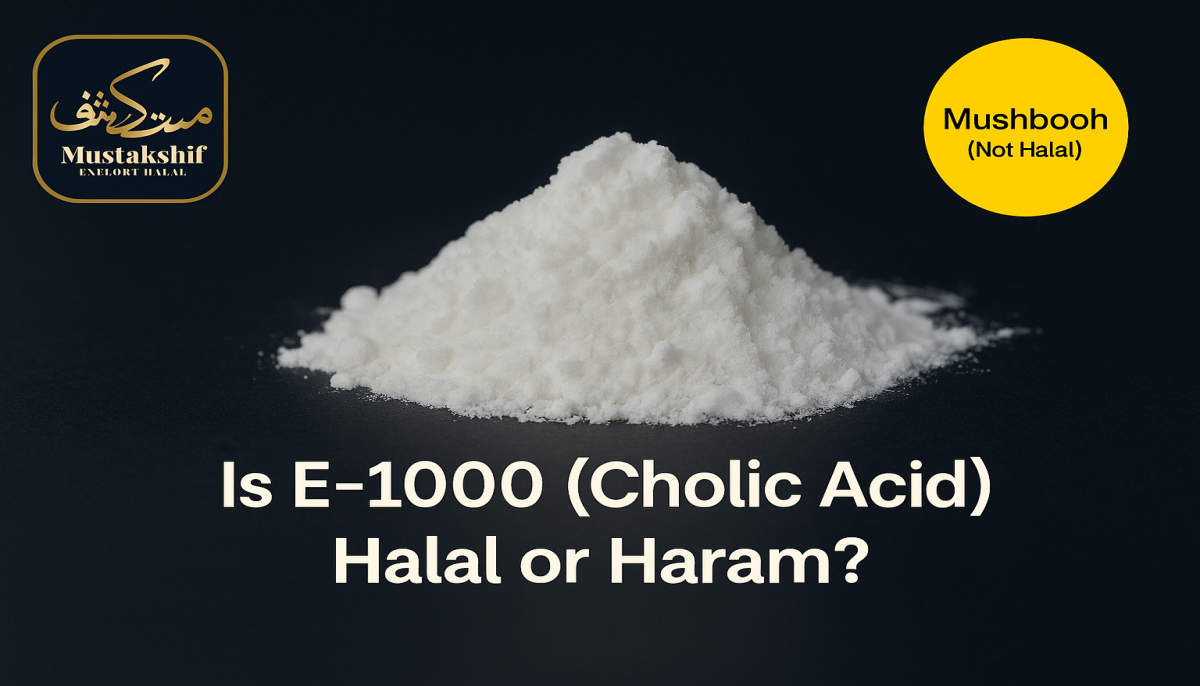
Mustakshif Shariah Board Rulings on E-1000 (Cholic Acid)
According to Mustakshif Shariah Board E-1000 (Cholic Acid) is classified as Mushbooh, meaning its permissibility is doubtful. This status is due to its animal origin. If the cholic acid is derived from animals not slaughtered according to Islamic laws, it may be considered Haram.
Furthermore, if the source is pig bile, it is unquestionably Haram according to Islamic Shariah. Since food labels rarely specify the exact source, its use becomes questionable for those following a Halal diet. Without clear certification or assurance of Halal sourcing, it remains in the Mushbooh category.
Fatwas Concerning the Ingredient
Currently, there are no widely issued fatwas specifically about E-1000. However, general Islamic rulings advise Muslims to avoid animal-derived additives unless their source is verified as Halal.
Introduction
E-1000 is the code for Cholic Acid or Cholin and its salt. It’s a water-soluble nutrient that is commonly referred to as Choline Bitartrate in food products and known by several other names, including Choline, 3α,7α,12α-Trihydroxy-5β-cholan-24-oic acid, and bile acid. This additive is recognised as an emulsifier and flavour enhancer.
Source and extraction method
The main source of this flavour enhancer is the bile of animals, including humans and mammals. Bile is a digestive fluid produced by the liver and stored in the gallbladder of mammals, including humans and other animals.
Once extracted, the raw cholic acid undergoes purification and processing to remove impurities. This ensures that the final product meets strict food-grade standards and is safe for use as a food additive.
Function of Cholic Acid
In food production, E-1000 serves two primary functions:
- Emulsification: It helps break down and mix fats with water, aiding digestion and creating stable fat-based mixtures in processed foods.
- Flavour Enhancement: It may improve the taste of meat products or fatty foods by aiding in the release of flavour compounds.
In some cases, it’s also used as a digestive aid, particularly in medical formulations or dietary supplements.
Conclusion
E-1000, or cholic acid, is a food additive used for emulsifying fats and enhancing flavour. However, its animal origin and lack of clear sourcing place it in the Mushbooh category. Consumers seeking Halal assurance are advised to avoid products containing E-1000 unless verified by a trusted Halal authority