Mustakshif Shariah Board Rulings on E161 (g) Canthaxanthin
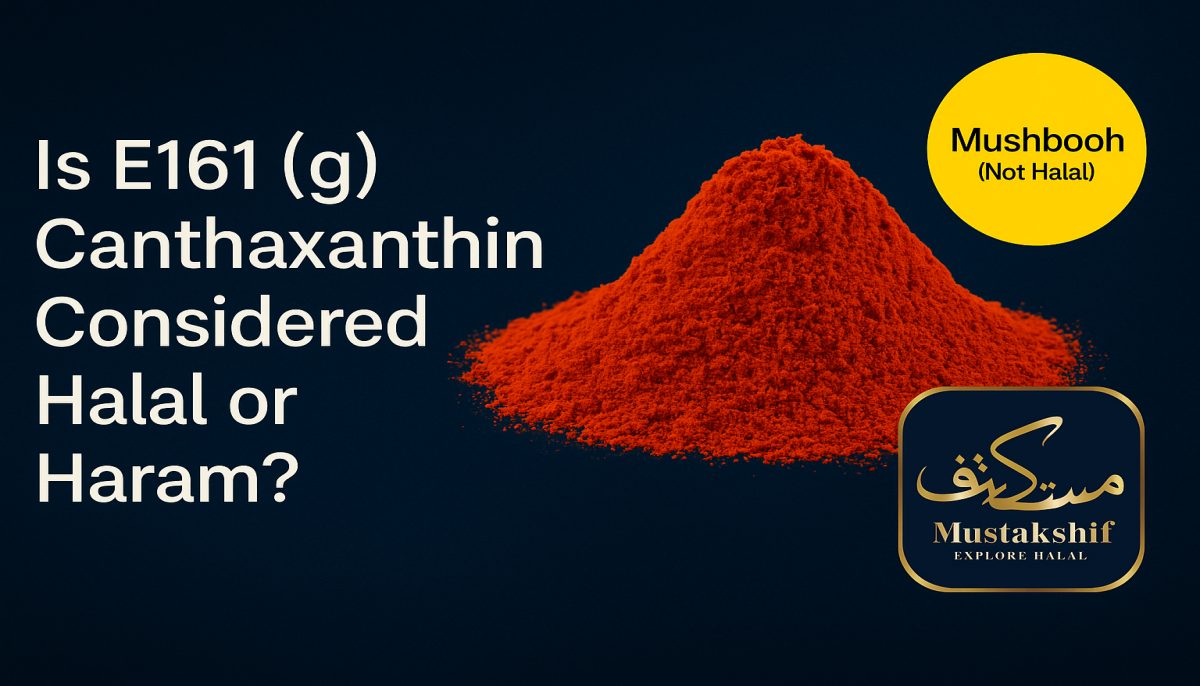
According to Mustakshif Shariah Board, E161 (g) is classified as mushbooh, meaning uncertain. Though it occurs in nature, doubts arise from the method of production. When sourced from synthetic chemicals or non-halal biological matter, its permissibility becomes questionable. Without clear confirmation of origin, scholars lean towards caution.
Scholarly perspectives on canthaxanthin
Some Islamic scholars advise against consuming E161 (g) unless its origin is fully verified. Due to the ambiguous sourcing methods, particularly chemical synthesis or extraction from questionable organisms, many consider it best to avoid unless a halal certification is present. Fatwas vary by region and school of thought.
Knowing canthaxanthin – what is E161 (g)?
Labelled as E161 (g), canthaxanthin is a colouring agent belonging to the carotenoid family. It appears naturally in plants, algae, and certain microorganisms. Some birds' feathers and fish skin also carry this pigment. Within the food industry, it may be called food orange 8 or carophyll red. This compound brings a reddish-orange shade to foods, enhancing appearance and appeal.
Methods of sourcing and creating canthaxanthin
Categorised as a colourant, canthaxanthin comes from both organic and synthetic routes. Naturally, it is extracted from algae and bacteria using solvents and refined through purification. In laboratories, it is produced by two primary techniques: chemical synthesis, where intermediates undergo condensation or extraction from biological sources like bacteria and fungi. Solvent-based purification ensures high-quality pigment isolation. Both methods aim to achieve a stable, colour-rich compound suited for industrial use.
How is canthaxanthin used across industries?
In food applications, canthaxanthin boosts visual appeal. Fish fingers, mallow biscuits, pickles, sauces, and even ice cream benefit from its vivid tone. Beyond edibles, it's added to poultry feed to intensify yolk and skin colour. The cosmetic field includes it in tinted products. Pharmaceutical firms employ this additive in tablet and capsule coatings to distinguish dosages and formulations.
Final thoughts
Canthaxanthin, or E161 (g), serves as a food colourant across many products. Its vibrant appearance makes it a favourite in both food and non-food sectors. However, its mushbooh status leaves consumers uncertain. For those mindful of halal standards, verifying its source before use is recommended.