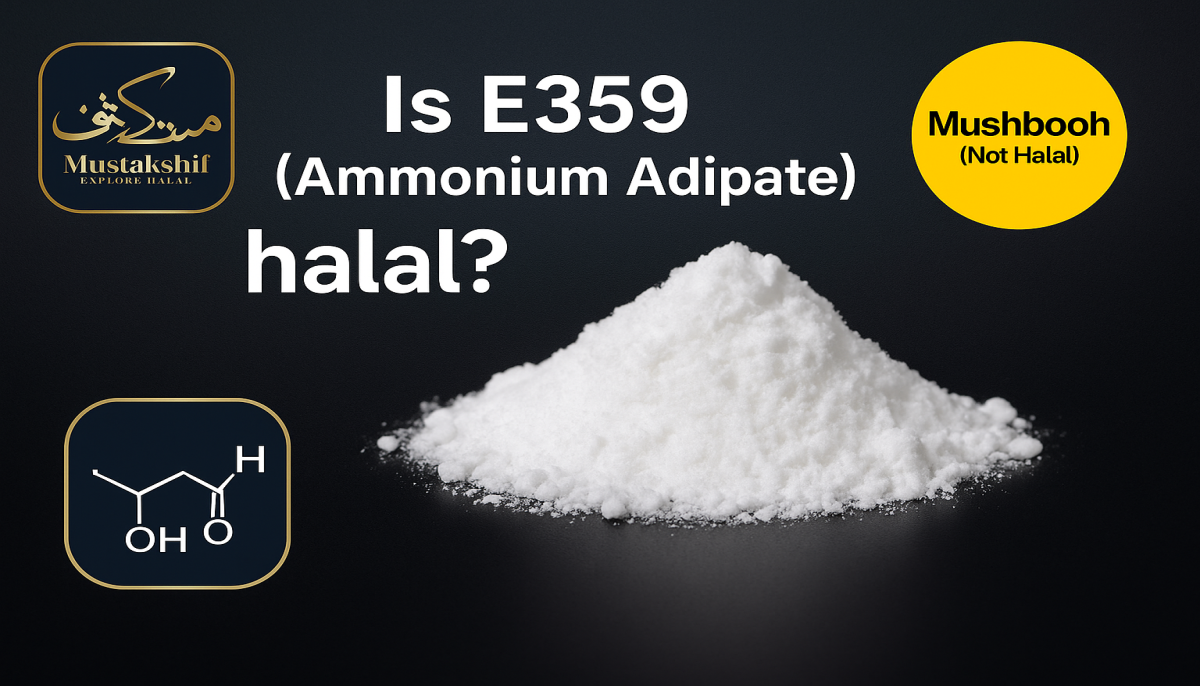
Mustakshif Shariah Board Rulings on E359 (Ammonium Adipate)
According to Mustakshif Shariah Board, E359 is made synthetically and does not involve any ingredients made from animals or haram substances. It can be the possibility that non-halal substances could be used as processing aids or contaminants. Therefore, some scholars may label it as masbooh (doubtful) until it is declared halal by certification.
Introduction of Ingredient
E359 refers to Ammonium Adipate, a chemical compound formed from adipic acid and ammonia. Multiple names, such as diammonium hexanedioate or adipic acid diammonium salt, are used to express this buffering agent. E359 is used primarily for controlling acidity levels in the food industry. This compound is known as a food additive and is registered under the European E-number system for use in food products.
How is it extracted?
Ammonium adipate is made synthetically by a chemical process rather than being derived from natural sources. It is created by using ammonia to neutralise adipic acid. Adipic acid is a compound that is often made from oxidising petrochemical substances like cyclohexane. The source is considered non-biological and synthetic, as both ammonia and adipic acid are byproducts of industrial chemical production and do not contain elements obtained from animals.
Functions of ammonium adipate
E359 is widely used in processed foods for the following purposes:
- Acts as an acidity regulator to balance pH levels in food and beverages
- Functions as a buffering agent to stabilise acidity or alkalinity
- Enhances shelf stability of products by controlling chemical reactions related to pH
- It can be found in items like powdered drink mixes, processed sauces, gelatin products, and other food items as an acidity controller & for better preservation.
Conclusion
Ammonium adipate, or E359, is a synthetic food ingredient used to control acidity. It is typically accepted as halal because of its synthetic, non-animal origin and lack of haram elements in its normal production method. Consumers should seek halal certification due to the complex nature of ingredient sourcing and acquisition in the food sector.