Mustakshif Shariah Board Rulings on E415 (Xanthan Gum)
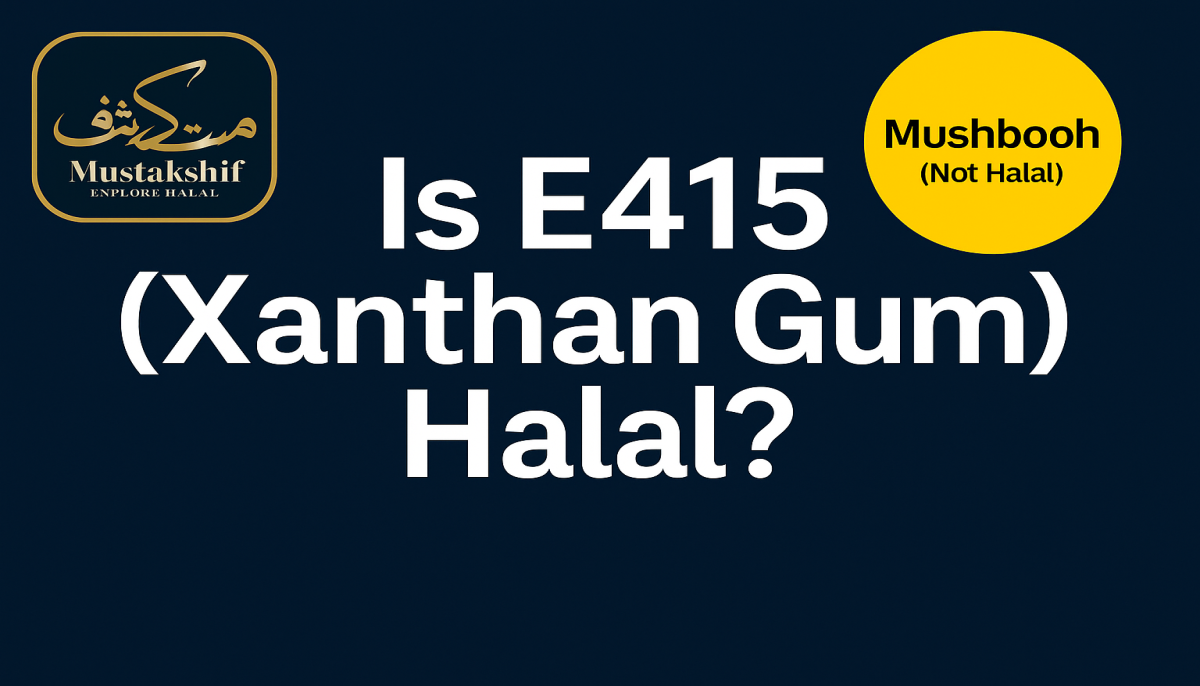
According to Mustakshif Shariah Board, E415 (Xanthan Gum) is classified as Mushbooh (not Halal) meaning its status is still unknown. Although the main ingredients, sucrose and glucose, are unproblematic, there is uncertainty over their origins. Doubts are raised if they are produced using dubious fermentation substrates or processed using uncertain machinery. In the absence of appropriate verification, eating may not comply with halal dietary regulations.
Fatwas and scholarly views
Regarding xanthan gum, a number of academics and halal-certifying authorities are cautious. Traceability, if all ingredients used in fermentation and processing are halal-compliant, often determines whether it is acceptable. Therefore, customers are advised to confirm halal certification before eating.
Introducing the ingredient E415
Xanthan gum, labelled under E415, falls under the category of polysaccharide gums. It serves as a food additive and thickener across several sectors. Names such as xanthan and polysaccharide gum are also used to describe this compound. It is mostly used in items ranging from food to medications that need a solid, smooth texture.
Production and sourcing process
Produced via bacterial action, xanthan gum forms when Xanthomonas campestris ferments sugars like glucose. The process involves:
- Cultivating the bacteria in a nutrient-rich medium.
- Harvesting the viscous gel post-fermentation.
- Purifying and dehydrating the substance into a fine powder.
How it functions, and where it’s used
E415 improves the consistency of a variety of products. In the food industry, it can be found in frozen desserts, salad dressings, and gluten-free goods. In the cosmetic industry, it is used in lotions, gels, and creams in addition to consumables. It is frequently used as a suspension stabiliser in medical compositions. Its ability to increase viscosity in hydraulic fracturing fluids is advantageous even to the oil business.
Final thoughts
E415, or xanthan gum, brings texture, stability, and thickness to a wide variety of products. Its origin in microbial fermentation of carbohydrates makes it effective but also uncertain from a halal standpoint. When verified, it can be acceptable; without certification, it remains questionable.