Mustakshif Shariah Board Rulings on E433: Polysorbate 80
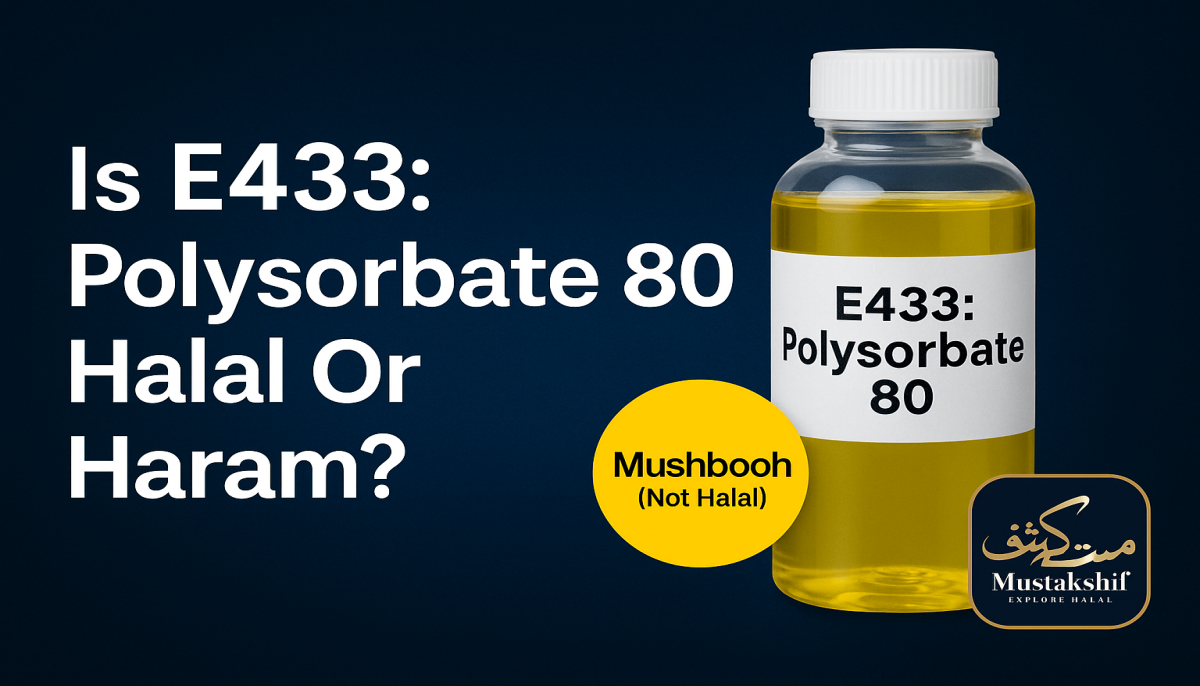
According to Mustakshif Shariah Board, E433 is mushbooh or doubtful because its source can be either plant-based or animal-based. If animal fats used are from non-halal animals or not slaughtered according to Islamic law, then E433 would be haram. If it’s fully plant-based and produced under halal conditions, it is considered halal. Since manufacturers often do not specify the source, many scholars advise caution.
Fatwas Concerning the Ingredient
Several Islamic scholars and halal certification bodies recommend avoiding E433 unless clear halal certification is available. Some fatwas classify it as mushbooh due to uncertainty in sources, urging consumers to choose verified halal products.
Introduction
E433 is known as Polysorbate 80, a widely used food additive. It is also called polyoxyethylene (20) sorbitan monooleate. This ingredient appears as a yellowish liquid and acts as an emulsifier and stabiliser in many processed foods. It helps mix ingredients that usually don’t blend well, such as oil and water.
How is it extracted?
Polysorbate 80 is produced through a synthetic process involving multiple steps. First, sorbitol is esterified with fatty acids, typically oleic acid, to form sorbitan esters. These esters then undergo ethoxylation, where they react with ethylene oxide to introduce polyoxyethylene chains, resulting in polysorbate 80. The final product is carefully purified to eliminate any residual reactants or by-products. It is then tested to ensure it meets food-grade standards for safety, stability, and functionality in food, pharmaceutical, or cosmetic applications.
Usage
E433 is primarily used as an emulsifier and stabiliser in foods like ice cream, salad dressings, baked goods, and sauces. It helps maintain texture, improve shelf life, and prevent the separation of ingredients. It is also used in pharmaceuticals and cosmetics for similar reasons.
Conclusion
polysorbate 80 is a synthetically produced emulsifier derived from sorbitol and fatty acids. Its safety and functionality depend on proper purification and testing, making halal certification important for Muslim consumers concerned about its source and processing.