Mustakshif Shariah Board Rulings on E483 (Stearyl Tartrate)
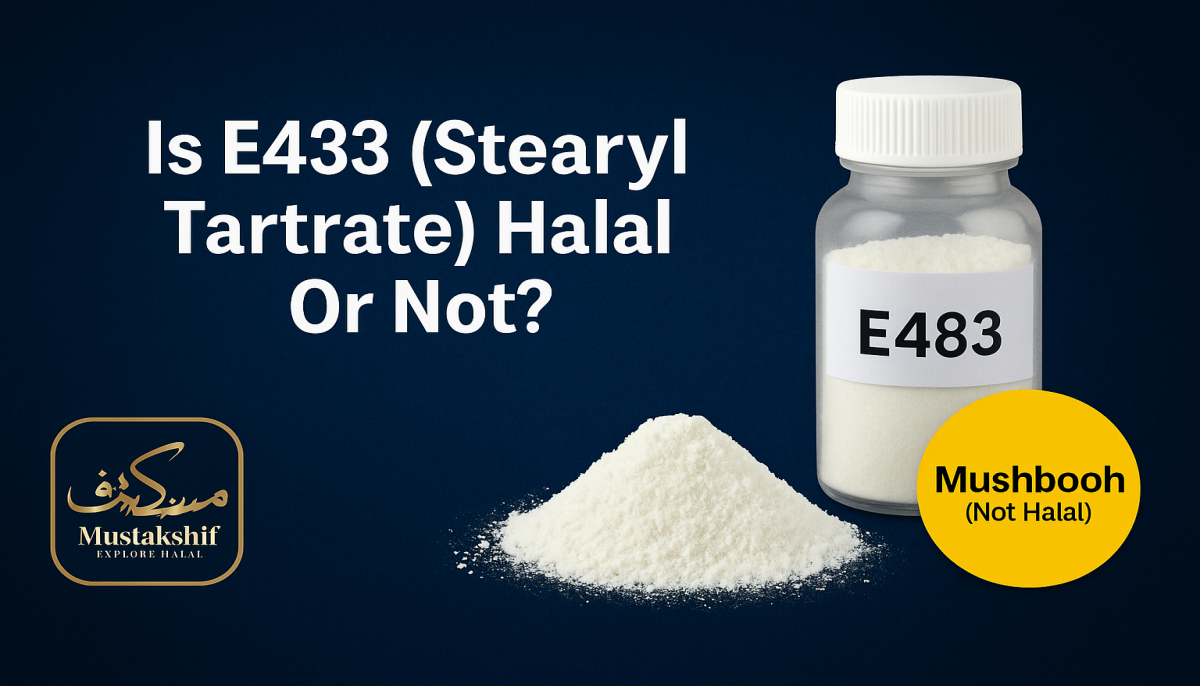
According to Mustakshif Shariah Board, E483 is classified as Mushbooh (doubtful) in Islamic dietary law. The reason lies in the origin of stearic acid. If it’s derived from non-halal animal fat, the additive becomes haram. However, if plant-based sources are confirmed, then it is halal. Since food labels rarely specify the origin, it remains questionable unless certified.
Fatwas Concerning the Ingredient
Several Islamic scholars and halal certification bodies state that E483 is not permissible unless its source is clearly plant-based. When uncertain, it is advised to remain cautious in following halal dietary laws.
Introduction of Ingredient
E483, also known as Stearyl Tartrate, is a food additive that is also known by some other names, like Tartrated Stearyl Alcohol and Stearyl Tartaric Acid Ester. It appears as a white or off-white powder and is used to improve the consistency and shelf life of processed foods.
Source & Extraction
E483 is a synthetic ester, created by combining stearic acid with tartaric acid. The tartaric acid is usually derived from natural plant sources like grapes. However, the stearic acid may come from either plant oils or animal fats. The production process involves esterification under controlled conditions. This uncertainty in the stearic acid’s source is where the concern begins.
Usage
E483 functions mainly as an emulsifier. It helps blend water and oil components in products like baked goods, margarine, and spreads. It also improves texture and prevents separation in processed foods, making them more uniform and stable.
Conclusion
E483 (Stearyl Tartrate) plays a useful role in food processing but may pose concerns due to its source. Without halal verification, its consumption remains Mushbooh. Always check for halal certification to ensure its permissibility.