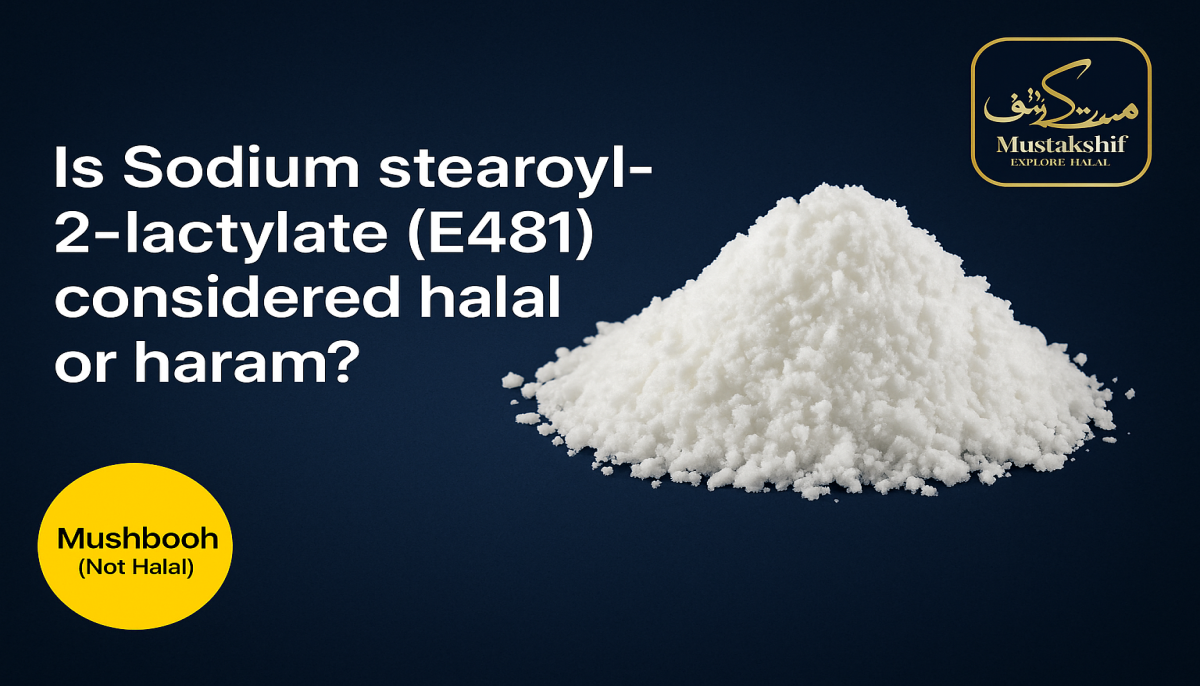
Mustakshif Shariah Board Rulings on Sodium stearoyl-2-lactylate (E481)
According to Mustakshif Shariah Board, Sodium stearoyl-2-lactylate (E481) is considered mushbooh, doubtful. Without clear confirmation that stearic acid comes exclusively from vegetable sources, uncertainty remains. It may be suitable for vegetarians only if labelled plant-based.
Fatwas and scholarly opinions
No widespread or unified fatwas confirm its permissibility. Scholars advise caution unless manufacturers guarantee non-animal origins.
What Is E481?
Sodium stearoyl-2-lactylate, coded as E481, appears on countless food labels. Often abbreviated as SSL, this compound serves as both an emulsifier and a dough conditioner in everyday products. Alternative names include sodium stearoyl lactylate and sodium stearoyl-2-lactylate. This synthetic compound ensures uniformity in food products, from bread to margarine.
Production and origin
This additive is made artificially. Stearic acid and lactic acid react to start production. After being esterified, sodium hydroxide is used to neutralise these two compounds. Purification is used to purify the finished product and get rid of any undesirable components and remaining raw materials.
Sources of stearic acid include animal fats or plant-based oils, such as palm or soybean, which means the origin may vary. Unless specifically plant-based, it raises questions about animal involvement.
What does E481 do in food?
SSL helps bind oil and water, promoting stable mixtures in margarine and dressings. In baking, it conditions dough, helping it rise better and feel softer. Shelf life is also extended, as SSL prevents ingredient separation and helps maintain product integrity.
Places you’ll find it
- bakeries: boosts volume in loaves and keeps buns softer and longer
- dairy: stabilises products like ice cream and coffee creamer
- spreads: ensures smooth, even texture in margarine
- Sweets: enhances texture and longevity in chocolate and candy
Final thought
E481, or sodium stearoyl-2-lactylate, enhances texture and extends shelf life in multiple foods. Yet its ambiguous source makes it questionable in terms of halal dietary compliance. Checking product labels or contacting producers is the wisest approach.