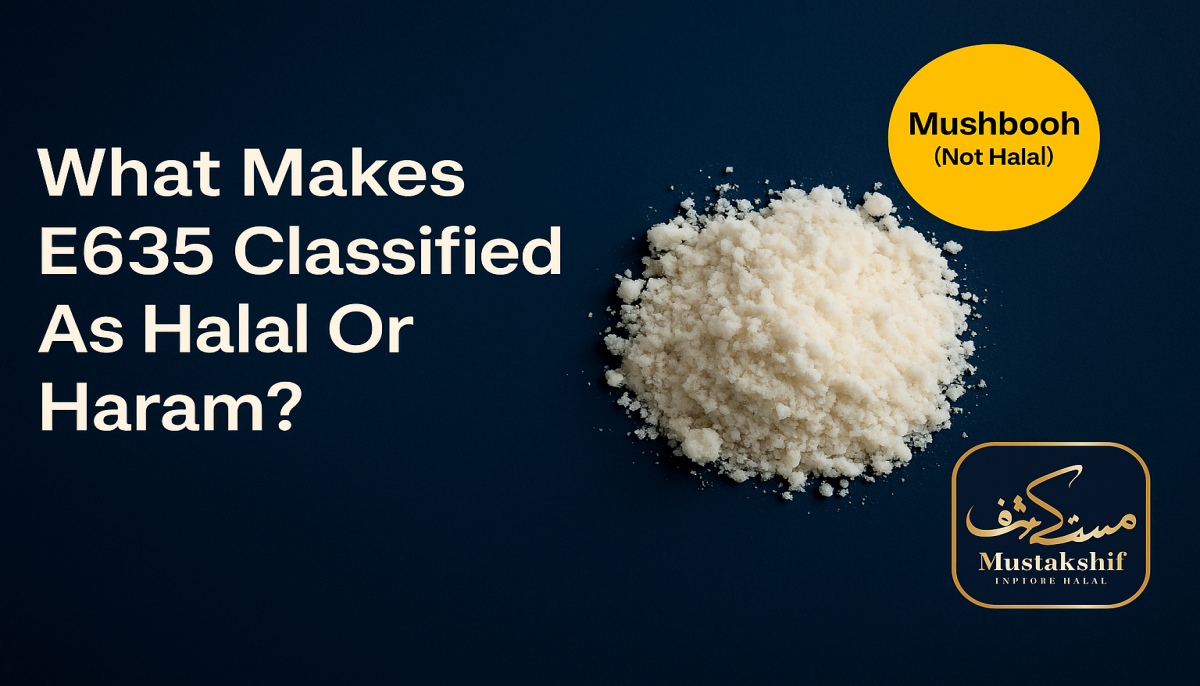
Mustakshif Shariah Board Rulings on E635
According to Mustakshif Shariah Board, E635 ingredient holds a mushbooh status. That’s because its sources vary. Although it may be derived from plant or microbial sources, it can also come from meat or fish. The uncertainty of e631’s origin, one of the main components of e635, creates doubt about its permissibility.
Fatwas guidance
Some scholars suggest avoiding e635 unless the source of e631 is verified as halal. If made from plants or microbial fermentation, it’s generally accepted. When sourced from meat or fish without clear halal certification, it remains doubtful.
E635 ingredient profile
E635 refers to sodium 5-ribonucleotide, a food additive used to intensify savoury flavours. This ingredient is well-known by other names, including sodium 5'-inosinate, sodium inosinate, sodium inosine monophosphate, sodium 5'-guanylate, disodium 5′-ribonucleotide, and i+g, a blend of inosinate and guanylate.
How is E635 derived?
The E635 ingredient is derived from sources such as yeast extract, fish, or meat. It may also come from fermented carbohydrates, such as glucose. Bacteria are involved in the fermentation process to create inosinate and guanylate. Once produced, these nucleotides are extracted and purified using filtration and crystallisation. Then, they’re neutralised with sodium hydroxide to form disodium salts. These salts are blended in a set ratio. Then they are dried and packaged for commercial use.
Common uses you should know
Sodium 5-ribonucleotide plays a key role in enhancing the taste of processed foods. It amplifies the effectiveness of other flavour enhancers like MSG, making it a popular choice in the food industry. The E635 is found in products like instant noodles, flavoured crisps, and frozen pies. Improving savoury notes and balancing the taste of processed meals.
Conclusion
E635 is a widely used food additive made from disodium inosinate and disodium guanylate. It helps boost the savoury flavour of processed items. Due to its mixed sources, its halal status remains unclear without proper sourcing information. Consumers should stay informed and verify the ingredients to align with their dietary preferences.