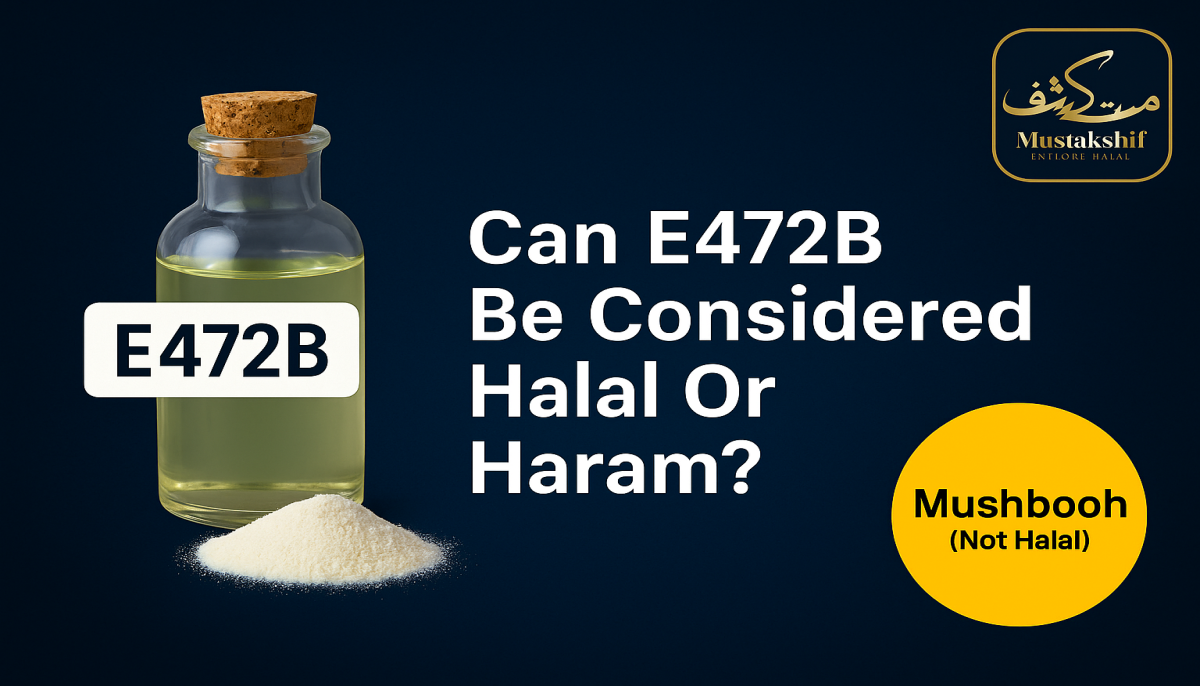
Mustakshif Shariah Board Rulings on E472 (Esters of mono- and diglycerides)
According to Mustakshif Shariah Board, E472 is classified as Mushbooh (not Halal) meaning its permissibility is doubtful. This uncertainty arises because the ingredient might be derived from either plant-based or animal-based fats. If the animal fat source is not halal-certified, the ingredient becomes questionable under Islamic dietary rules.
Religious views on E472 you should know
E472 (a–e) can come from plant, synthetic, or animal sources. If it’s not clearly labeled “suitable for vegetarians,” it may contain animal-derived ingredients.
As the Prophet (PBUH) said:
“Leave what makes you in doubt for what does not make you in doubt.” (Tirmidhi)
Best to avoid if unsure of the source.
Written by Maulana Moinul Abu Hamza
E472 Introduction
E472, also known as esters of mono- and diglycerides, is classified as a food emulsifier. This additive is commonly found in processed foods to help improve texture and maintain uniformity. Though no widely accepted synonyms exist, the ingredient might appear under technical labels referring to its specific ester forms (e.g., E472a to E472f).
Extraction and sources
E472 is produced through a stepwise process. The initial stage involves breaking down natural fats or oils into glycerol and fatty acids. Then, mono- and diglycerides are formed by combining glycerol with those fatty acids. In the final step, these glycerides are reacted with organic acids like acetic, lactic, citric, or tartaric acid to produce E472 esters. The original fats may come from plant oils such as soybean, palm, or sunflower. In some cases, animal fats may also be used, which makes the source variable.
Functions and uses in food
This additive plays a vital role in enhancing the quality of food items. It acts as an emulsifier, helping to mix substances like oil and water. In addition, E472 works as a stabiliser by keeping mixtures from separating. Its texturising ability ensures creaminess in desserts and softness in baked items. These functions make it indispensable in various sectors, including baking, dairy, confectionery, and processed meals.
Conclusion
E472, or esters of mono- and diglycerides, is a widely used food additive serving multiple purposes in the food industry. While it offers practical benefits like emulsification and texture improvement, its unclear origin makes it mushbooh in Islamic law. Consumers concerned with halal compliance should verify the source or opt for certified alternatives.