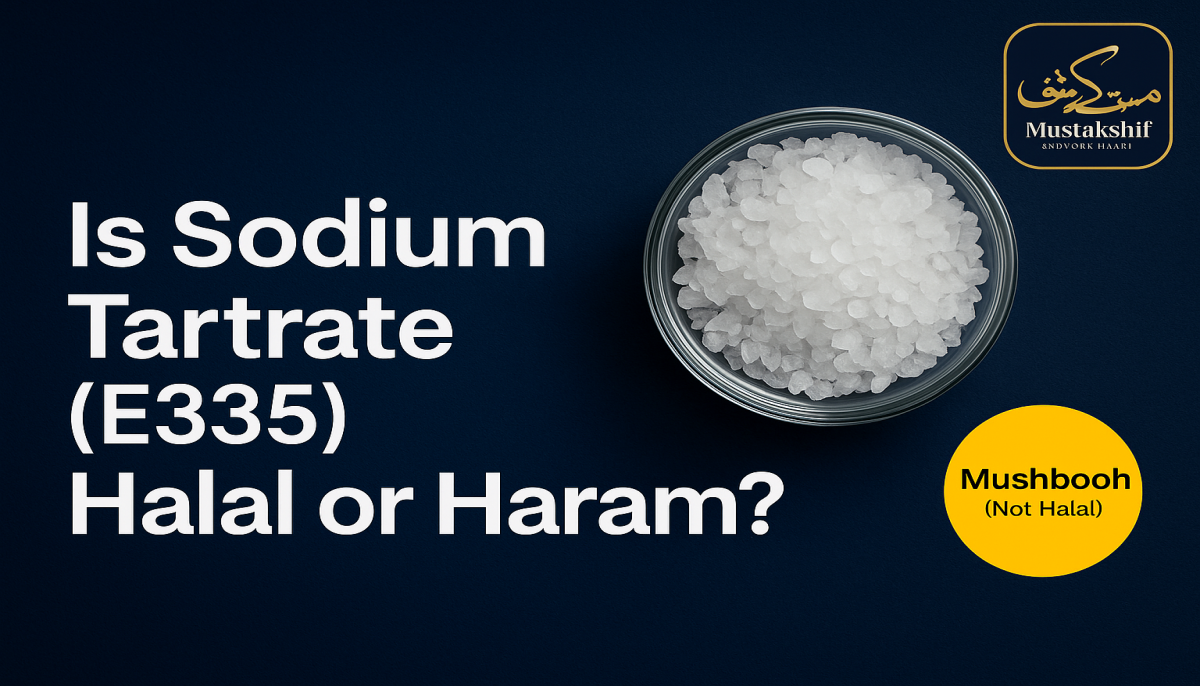
Mustakshif Shariah Board Rulings on Sodium Tartrate (E335)
According to Mustakshif Shariah Board, the classification of E335 remains mushbooh (questionable). Although derived from plant-based tartaric acid, its mushbooh status arises due to the potential use of non-halal substances during processing or contamination with impure materials. Sodium hydroxide used for neutralisation could originate from animal-based or chemically questionable sources, depending on the supplier’s practices.
Fatwas and scholarly positions
Several Islamic scholars and food regulatory bodies regard sodium tartrate as mushbooh unless its source and production methods are verified to be fully plant-based and free from cross-contamination. No definitive fatwa rules it as halal or haram without complete transparency from manufacturers. Thus, Muslim consumers are advised to consult with certification authorities or opt for alternatives bearing halal certification.
Introduction to E335
E335, widely recognised as sodium tartrate, is commonly used in the food and pharmaceutical industries. Also called disodium tartrate, sodium l-tartrate, or tartaric acid disodium salt, this additive functions primarily as a stabiliser and acidity regulator. Manufacturers rely on it to enhance texture and preserve pH levels in a wide range of products.
Natural beginnings and production process
Sodium tartrate is classified as a stabiliser and acidity regulator derived from natural sources. Its origin traces back to tartaric acid, which naturally occurs in plants, especially grapes. Much of the world’s supply comes as a by-product of wine making.
The production begins with the extraction of tartaric acid from grape residues. Sodium hydroxide is then used to neutralise this acid, resulting in sodium tartrate. Further refinement includes purification to eliminate unwanted substances, followed by crystallisation and drying to form the final compound.
Practical applications in food and medicine
As a stabilising agent, E335 prevents ingredient separation, maintaining product uniformity. Its role in acidity regulation helps preserve flavour and shelf life by keeping pH levels stable.
This compound appears in various items, including cheese, jellies with artificial sweeteners, and processed meats. Beyond food, it plays a role in pharmaceuticals as a stabilising excipient. Its function as a sequestrant also sees it employed in industrial and chemical processes, particularly where ion control is critical.
Final thoughts
Sodium tartrate, under the code E335, is a widely used additive with plant origins and industrial significance. However, due to its ambiguous production route, its consumption requires caution for those observing halal dietary laws. Careful label reading and sourcing from certified producers remain essential steps for making informed choices.